Abstract
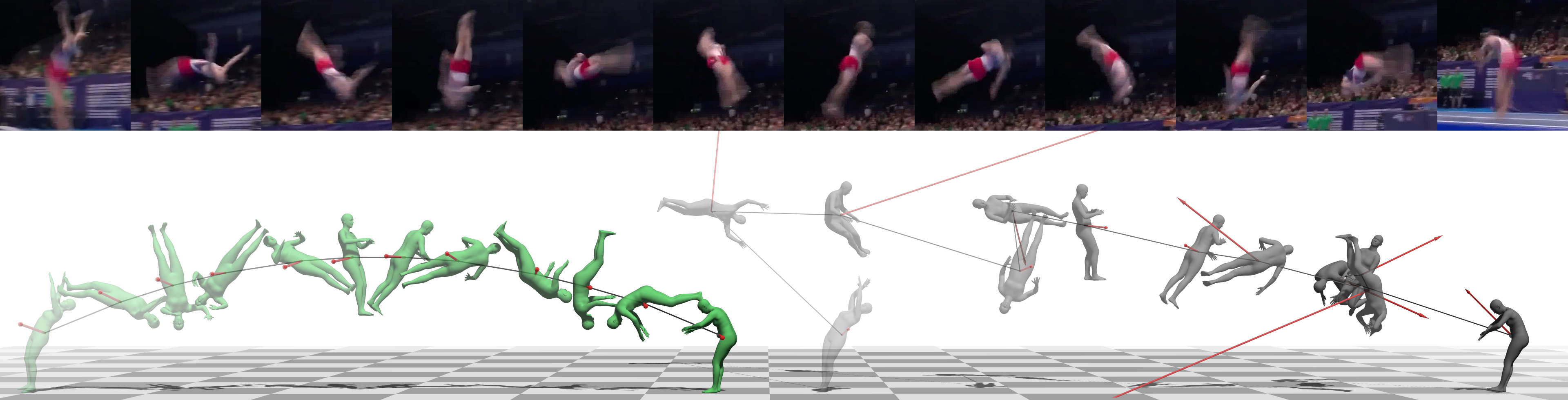
Monocular video-based human mesh recovery (HMR) has made significant progress in recent years, yet existing methods often fail to reconstruct physically plausible motion during highly dynamic airborne movements such as jumping or acrobatics. These failure cases arise from motion blur, rapid orientation changes, and the lack of suitable training data, leading to temporally inconsistent and physically implausible results. We propose a novel method for reconstructing 3D airborne motion by refining inaccurate estimates produced by state-of-the-art HMR systems. Our approach extracts key physical quantities, identifies reliable motion segments based on physical consistency, and connects them using a homotopy-aware trajectory optimization. A global angular momentum constraint is then enforced over the entire motion, and global motion and local poses are jointly optimized under physical and temporal smoothness constraints. Experiments on challenging in-the-wild videos demonstrate that our method produces more physically consistent and temporally coherent airborne motions than existing refinement approaches.
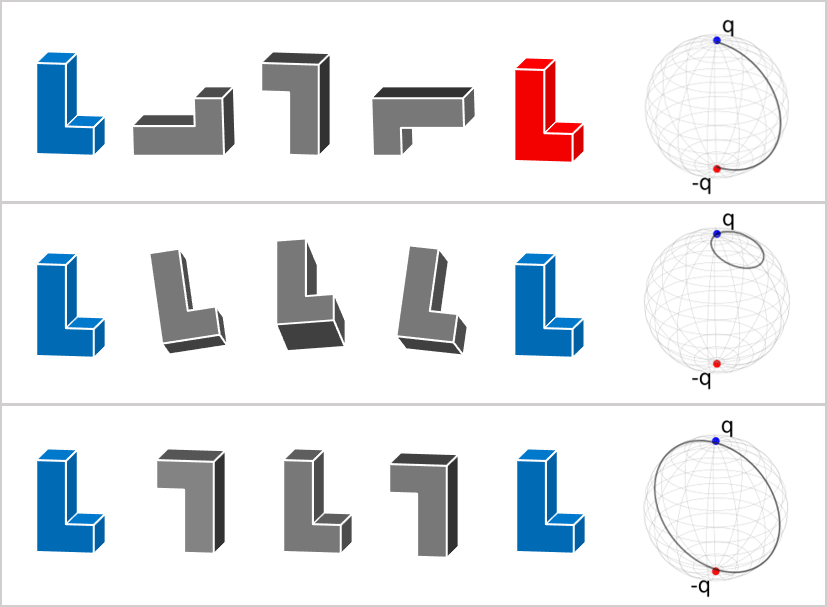
Homotopy Classes of Rotational Trajectory
Results
BibTeX
@inproceedings{10.1145/3799902.3811070,
    author    = {Kim, Chanha and Won, Jungdam},
    title     = {AMOR: Airborne Motion Reconstruction via Homotopy-Aware Trajectory Optimization},
    year      = {2026},
    doi       = {10.1145/3799902.3811070},
    booktitle = {SIGGRAPH Conference Papers '26},
}